Showing posts with label Espresso Book Machine. Show all posts

Thursday, May 03, 2018

Tell Me About The Early Days of Self-Publishing, George


The other day, while putting together material for my forthcoming Free Friday Frights, I was looking into the origin of the chapbook Active Reader that I had initially created in print.

It led back to 2008 when I had purchased an Espresso Book Machine for the then-bookstore at McMaster University which had been called Titles Bookstore, and we launched a "Titles on Demand" business using a large print-on-demand machine from On Demand Books.

We were the 2nd location in Canada and the 9th in the world to own an Espresso Book Machine. Exciting times.

And, of course, it was the early days of what was about to become the large self-publishing "Gold Rush" of 2011 / 2012. (To be honest, we're still in the early days of self-publishing, as, each year, thousands of more authors learn about the amazing possibilities of what they can do related to selling eBooks globally)

An article from the Dec 2008 McMaster Times
It was my work helping local authors who were interested in print (POD) self-publishing that eventually led me to my role as Director of Self-Publishing & Author Relations at Kobo. Because, as amazing as the machine and having print-on-demand access was, I was still running into the issue of people in countries on the other side of the globe wanting access to locally produced books. So I helped the authors create eBook versions to load to Kindle and Kobo, so we didn't have to worry about shipping costs or logistics.

Pic from Hamilton Spectator article - The EBM, Donna (Bookstore Director) & me
Because the machine required a lot of testing; and, particularly in the early days of the machine, we were doing dozens of tours and demonstrations of it, we needed to create some smaller books so that we could go through the demonstrations quickly (also, without using a ton of paper - ie, printing a 300 page book). So I created a chapbook of about 50 pages that contained three of my previously published short stories. It was easier to use one of my own pieces of writing that I had the rights to than to worry about violating some sort of copyright.

I called the chapbook Active Reader: And Other Cautionary Tales from the Book World.


Of course, once I moved from McMaster to Kobo, and needed to have files to test the eBook self-publishing system (Kobo Writing Life) I had been responsible for creating there, I converted the book into eBook format.


 And, in mid 2017, I then had the book converted into audiobook format using Findaway Voices.


It was interesting how, when doing a book in print, you needed to have a minimum page count in order for the book to be properly bound using certain binding technologies. (For POD, I think the minimum page count that worked well might be somewhere between 30 and 40 pages). The maximum page count for an Espresso Book Machine was somewhere in the 550 to 600 page range. Of course, for ebooks, there's no minimum and no limit. As I have enjoyed sharing when talking to audiences who aren't familiar with ebooks, "you aren't limited to the standard format of 300 pages bound between two pieces of cloth."

Funny to look back about ten years ago and see what I had been up to.

Remembering how cutting-edge this POD machine in a bookstore was, I was only beginning to understand the power of digital publishing.

Who would have guessed what these past ten years have actually entailed?

In many ways it feels like only a few years have passed since I was cranking out POD books at the bookstore at McMaster and sharing the possibilities of that brave new world with anyone who would listen; in other ways, it feels like at least twenty years ago.

Friday, April 05, 2013

They Say You Want A Revolution . . .

 . . . well, you know, we all want to change the world.


Sorry, I couldn't resist the title for this blog post.  Not when it's about Emily Craven's E-Book Revolution Podcast. She wants to change the world for the better, and her blog and podcast are two places where she does that, by providing interesting and valuable content for authors.

I had the pleasure of meeting Emily at World Fantasy Con in Toronto in late 2012, and we recently synced up to further discuss all the writerly things we had chatted about when we met at that con.


During this hour long discussion, Emily and I chat about

  • The benefits of self-publishing as well as my love of being a hybrid author
  • How indie authors and Kobo are partnering with bricks & mortar book stores and how Kobo Writing Life authors can take advantage of that.
  • How a digital author can sell copies of their work at events and functions in the real world
    A bit about my experiences using the POD Espresso Book Machine and how indie authors can take advantage of them either locally or through Lightning Source
  • How self-published authors can use Kobo Writing Life to sell pre-orders of their books.
    The fun of global book launches.
  • How traditionally published authors can use self-publishing to bring new life to their out-of-print back list to increase the sales of their front list from publishers.
  • Why the 99 cent model and drive to free and zero pricing is unnecessary and can be detrimental for authors in the long term.
  • I, of course, also slip in a few blatant self-promotion moments - how couldn't I ask people to check out my books?

We also talk about really smart publisher moves such as Harlequin's recent purchase of print rights of Bella Andre's The Sullivans novels, and Hugh Howey's similar deal with Simon & Schuster for WOOL.

In all, it's two writers talking about writing (which is always a good time for this book nerd), but if you listen very carefully, throughout the entire podcast there's a very subtle, almost undetectable sound of me switching the multiple hats I wear as author, bookseller and self-pub guy at Kobo.


Click here to go to the podcast website.

Or right click and download the mp3 file.

To check out Emily's books (at Kobo, of course - you know you wanna), click here - or check them out on her website.

Thursday, July 05, 2012

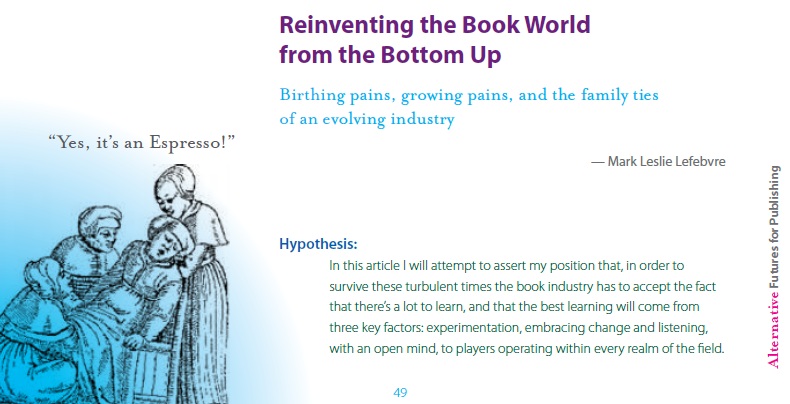
Reinventing The Book World From The Bottom Up

I wrote a chapter for a recently released book ALTERNATIVE FUTURES FOR PUBLISHING entitled "Reinventing the Book World from the Bottom Up."  The book was put together via a very workshop sponsored by the Alberta Book Publisher's Association.  (I blogged about the 2 day workshop I attended back in March)


The book is available in PDF format and downloadable (but be patient, it's 6.3MB) and includes many links to videos, audio and other handy resources related to the articles.

My chapter focuses on experiments within the POD space using an Espresso Book Machine in a bookstore as well as my observations (from a bookseller perspective) regarding eBooks and the digitization of books.


Here's how my article opens....

I honestly can’t remember what bookish tech-style conference I had heard this.
It was either at one of the annual BookNet Canada Tech Forums or perhaps it
was the first BookCampTO event; but somewhere in the tweet-stream, during
a hearty discussion about the state of the book and publishing industry, the
forthcoming digital apocalypse and the advent of the ebook era, an audience
member from one of the sessions pushed out an intriguing tweet.

“The book isn’t dead; it just had babies.”
              —  
unattributed Twitter quote

I retweeted it, as did several others. It was a cute sentiment. It was simple, yet
it spoke volumes.

And, when you come to think about it, it’s a pretty accurate assessment for
what the publishing industry has been going through.

Though, unlike a typical labour (quick intense pain, and regardless of medical
or trained professionals or not, regardless of administration of painkilling
medication or not the baby is going to arrive within a limited period of time),
the publishing industry’s birthing experience has been extremely long and
painful. Something in the realm of 10 to 12 years.

Some would even suggest longer.

Ouch.

The article goes on in an extreme continuation of the analogy to illustrate a chaotic birthing room, my attempt to parallel the panicked reactions of various industry players to digitization. Then I discuss the concept of digital delivery and either digital consumption (eReading) or local printing (via POD).

You can read the entire article (and the entire book) for free by downloading it.  (The file is big, so be patient while it downloads)

Monday, March 26, 2012

Examining Alternative Futures For Publishing

Tonight after work I'm flying in to Edmonton where I will be participating in an exciting Book Publishers Association of Alberta (BPAA) publishing project.

Jerome Martin of Spotted Cow Press is heading up the project and contacted me a few months ago asking if I would participate in the project with 5 other writers to create an intriguing new book. We have each written a chapter roughly based on the theme of "Alternative Futures for what we currently call Publishing" and sent them in to Jerome.  He was reworked them into a standard format and re-distributed the to the group.

Middle Ages Tech support YouTube video - how to read a book rather than a scroll


On Tuesday March 27th and Wednesday March 28th we'll be gathering in Edmonton at The Enjoy Centre in St. Albert. 

Each author will discuss his or her chapter and the ideas which flow from it with the group, who will then offer suggestions on revisions, additions, links, audio or video. I am excited about this unique opportunity to work with a group of intelligent and knowledgeable people regarding an industry I am passionate about.

The last time I worked with Jerome was when his publishing company Spotted Cow Press did the world's first double espresso book launch back in 2009.  Martin's publishing company published an ebook by Susan Minsos called Squire Davis and the Crazy River that was also created in print format using the Espresso Book Machine at the University of Alberta Bookstore.

Because the book had a "local" element to Hamilton (Minsos was originally from the Hamilton area), the book was launched in two locations. There was an arts festival happening in Edmonton where the book was being launched, and simultaneously a group of fans gathered at Titles Bookstore McMaster University to watch the event via a two way video feed where they could listen to the reading and ask the author questions and get copies of the books off the EBM in Hamilton. The author even signed book plates that were shipped to the Hamilton area customers afterwards.  That way they could begin reading the book immediately and insert the signed plates into the books afterward rather than waiting for a signed copy to be shipped.

Squire Davis is one of the books that Spotted Cow Press makes available in bundled format. When you buy the printed book, you get a free code for the electronic edition. (The ebook costs $3 without the purchase of a book) Martin has been doing this type of thing for years while elsewhere in the industry, the concept is still being considered and discussed as a possible thing to try.  (Marvel Comics, for example recently announced free digital versions for customers who purchased select comic titles and has been getting a lot of press about it as bold and innovative)

These will be just one of the opportunitys we will be exploring when we explore the future of publishing in our two days of working on this exciting new publishing project.  The chapter I have written is currently subtitled:  "Birthing pains, growing pains and the family ties of an evolving industry." But the cool thing is going to be how what I've currently written evolves after the two days of workshopping.

I'm so looking forward to this experience, and with sharing our activities.

The twitter hashtag will be #altfuturespublishing.

Saturday, December 31, 2011

Navigating the Digital Tipping Point of the Book World

I collected a group of essays I wrote which were originally published on The Mark News website. I've been writing a series of articles there which are mostly reflections on the publishing industry from a bookseller's perspective.

I recently made the book (Living at the Tip) available via Amazon - it's actually exclusive to Amazon. I know, I know - how ironic considering that many of the articles criticize the behemoth and that I mostly work in rivalry to them. But such is this grey world we live in.

In any case, the ebook, which normally retails for $1.99, is free for the next couple of days.


Living at the Tip: Navigating the Digital Tipping Point of the Book World

We’ve been at the tipping point between traditionally printed and digital books for well over 10 years. Looking around the industry, at one end you’ll find naysayers who continue to stick their heads in the sand, believing that digitization couldn’t possibly change a centuries-old industry, and at the other those who believe "The End is Nigh!" and all traditional players should just pack it in.

These articles, published on The Mark News between Nov 2009 and Oct 2011 outline one bookseller's perspective on the changes facing the industry and the possibilities that exist when exploring bold new collaboration between legacy traditions and new technology.

Monday, October 17, 2011

A Fun Play On Words (en français)

Although my last name is French (no, not "Leslie" - that's my middle name as well as part of my nom de plume), I'm not fluent in the French language.

Shame on me for that.

But I am trying. And working with a great group of folks at the University of Montreal (Université de Montréal) is helping me because it's given me a great excuse to try saying some things in French. And the best part about it is that everyone is so wonderfully accepting of the manner by which I'm gently murdering the French language that I'm not afraid to take large stabs at trying to express things in French. And when I stumble, everyone is helping me get it right.


And they are also very patiently explaining things to me.


For example, Simon, the Xerox rep whom I'm working quite closely with, explained the brilliant play on words on the sign for the U de M's forthcoming Espresso Book Machine launch later this week.


FAITES PARTIE DE L'HISTOIRE
IMPRIMEZ LA VOTRE


"Histoire" translates most closely to "history" but is also a synonym for "story" -- thus the play on words and the twofold message. Come to the opening of the EBM at U of Montreal and be part of history (ie, the evolution of printing). But, when printing your own book (imprimez la votre!) you're making your own story. So you're witnessing history AND being part of the story. Nice.


I'm just a sucker for a good play on words - no matter which language it's in. (J'aime un bon jeu sur les mots)


Okay, now back to my French lessons . . . (maintenant de retour à mon cours de français)

Tuesday, October 11, 2011

Turning Points

My article regarding the latest turning point in publishing with respect to print on demand and the Espresso Book Machine appears at The Mark News this morning. It is one of the 5 top featured stories scrolling through the initial landing page.


The article is my commentary on the recent HarperCollins announcement of making a batch of comprehensive backlist titles available through the Espresso Book Machine market and how I feel it marks a positive mindset change from one of the industries larger players.

As always, I'm impressed by the fantastic editing job done on the originally submitted article.

Check out my original post on Sept 24th "First Major Publisher Finally Gets It!" and compare it to the edited post "A Turning Point for the Publishing Industry" printed on The Mark News.

Yes, I believe that I have talent as a writer. I've been writing for almost thirty years now, continually plugging away at stringing words together to tell stories and share ideas. But I'm no fool in believing that my writing doesn't benefit from the fine surgeon-like skill of a good editor's touch. Simply, the editor's touch typically makes my writing shine, allows the things I am expressing to be more crisp and concise.

I believe that, in every writer's journey, there is likely a turning point in which they recognize that as hard as they work, as much as they revise, there's nothing that compares to getting to work with a really good editor. I was fortunate to benefit from learning that early on and have been able to use that knowledge to my advantage rather than get into ego-based fights with those whose goal it is to help refine and polish a raw piece of writing.

Three cheers for great editors!

Saturday, September 24, 2011

First Major Publisher Finally Gets It!


Last week in what I fully believe will become known as an historic turning point for the publishing industry, HarperCollins Publishers announced a partnership with On Demand Books (makers of the Espresso Book Machine) and something called “Comprehensive Backlist.”

The program will allow any physical bookstore with an Espresso Book Machine the ability to offer thousands of backlist trade paperback titles from HarperCollins to their customers. This means that the vision of walking into your local bookstore only to find the title out of stock and a wait of one to three weeks for that special order to arrive, a thing of the past.

Me and some of the first EBM titles at McMaster in 2009 in front of the EBM 1.5


Now, all the bookseller will need to do is look up the title in their Espresso Book Machine (EBM) catalogue, hit a few buttons, and the perfect bound trade paperback, complete with a full colour cover will be produced right there in the store in a matter of minutes.

This represents the very dream I had envisioned when I set about to purchase the Espresso Book Machine for the bookstore at McMaster back in 2008. Titles Bookstore at McMaster University was the 2nd location in Canada to acquire an EBM and, even though the catalogue of well over a million titles was immediately available, content from the major publishers was still part of the “coming soon” rather than the “feature attraction.” Instead of waiting for the inevitable content, McMaster took a “buy it and they will come” approach and haven’t looked back.

The EBM at McMaster has allowed us to partner with academic publishers to ensure the availability of custom versions of textbooks that helped us save students hundreds of thousands of dollars over the past three years, while increasing bookstore and publisher sell-thru. The EBM has also attracted an entirely new revenue stream due to our ability to offer services for self-publish authors. With an ideal print-run of 1 copy, anybody who ever wanted to follow the dream of publishing their own book saw some previous high barriers fall.

“Bookstores continue to be an important place for customers to shop for physical books,” Brian Murray, Chief Executive Officer at HarperCollins said in a September 22nd press release. “The goal of this initiative is to give the local bookseller the capability to provide customers with a greater selection of HarperCollins titles in a physical environment.”

Visionary Dane Neller, CEO of On Demand Books applauds HarperCollins on this move. “By committing thousands of titles to the program,” Neller says, “HarperCollins is showing its clear support for bookstores and authors, and reaching more readers.” Neller goes on to state that “Digital-to-Print at Retail” (DPR) will become a powerful new sales channel helping to eliminate lost sales due to out of stock inventory.
This is a day that I dreamed of when I first watched the EBM roll into the bookstore at McMaster University one fine day in November of 2008.

I knew that digital books and ebooks would continue to grow and eventually become a dominant force within the publishing market; but I have also long held the belief that there was a need for digital distribution with a “print local” element – allowing customers who still prefer the printed artefact purchased from their friendly neighbourhood local bookshop an easy way to get access to more titles than can be physically held in a small and often high rent retail space.

We have all seen evidence that bookstores attempting to stock upwards of 100,000 titles on their shelves is not always a fully sustainable business model. The McMaster bookstore, for example, which used to stock 40,000 titles in the store, eventually recognized that the cost of attempting to physically carry “everything” was simply not sustainable. It was the Espresso Book Machine and the continually growing digital catalogue of print on demand titles that allowed us to finally make the change and stop carrying so much backlist and overstock. We knew that the day would come when that backlist (or Chris Anderson’s “long tail” of titles would soon be available in a more convenient fashion for customers, booksellers and publishers thanks to our Espresso Book Machine.

Now that HarperCollins has stepped up to the plate, I’m sure that the other major publishing stakeholders will follow suit.

I’m rather enthusiastic to watch a fresh new opportunity that represents a win situation for publishers, bookstores and authors, particularly at this time of unease and unprecedented change in our industry.

Friday, March 18, 2011

This Man Is An Author

So yesterday I was surprised to discover a picture of me in a Globe & Mail article by John Barber called Getting a read on the future of publishing. It's part of what has been an interesting series of TIME TO LEAD articles they've been running.

The article looks at various innovations taking place within Canada and around the world in the publishing industry.

One of the things they mention is the Espresso Book Machine.

And it looks like they used an old file photo of the EBM at McMaster from back in 2008 when we first got our machine and the G&M came to visit Titles Bookstore.

There I am in a picture accompanying the article, gazing lovingly at the book From the Earth to the Moon by Jules Verne seconds after it has been bound and just as it has been passed off to the robot arm that is about to move it into position for the bottom to be trimmed.

Photo by Glenn Lowson for Globe & Mail

That's why, when I saw this video posted on a recent MOBYLIVES blog post this morning, I giggled, thinking about the differences between this process from 1947 and what the process can be now. (Again, I'm just talking about the process of making a physical copy of the book, not the writing process, nor anything related to digital distribution - you know, for simplicity's sake.)

I love the way the narration in this video begins:

"This man is an author. He writes stories. He has just finished writing a story. He thinks many people will like to read it. So, he must have the story made into a book."


Oh yes, he thinks many people will like to read it.  It would be fun to spoof the narration of the video and change it and incorporate the self-publish process available on the Espresso Book Machine now. You know, have the narrator say something along the lines of: 

"But the author knows that no agent, publisher or editor is likely to select it from a warehouse full of manuscripts they have to wade through. That pile of manuscripts is called a slush pile. So, the author decides he'd rather just print the book himself at his local bookstore."

Or maybe:

"But the author is impatient. He knows it'll take forever, and he wants to see his book printed today. After all, it took him 4 hours to write the book. Why should it take longer to publish it? And besides, who needs an editor? He is a talented genius after all. So . . ."

Or, the spoof could head down the dark-humour path:

"But he is wrong. Nobody wants to read his book. Back in 1947 he might have drank too much and then reached into his drawer for his Smith & Wesson handgun to end it all. But not today. Today, he can get his book printed; quickly, easily and without having to remortgage his home."

So many ways to spoof the original video. But in any case, I think it's cute to watch both processes side by side.

Video of how books are made circa 1947 - "Making Books is Fun (To Watch)"


Video of the Espresso Book Machine circa 2009 (there are newer, slicker models available now - too bad there aren't that many slicker and really short videos showing the machine)

Wednesday, August 18, 2010

A Bookstore Without Books?

Via Twitter, a publishing friend and visionary, Dominique Raccah, forwarded me an interesting article from Publishing Perspectives.

The article, entitled "Could You Run a Bookstore With Just an Espresso Book Machine?" asks an interesting question.  As someone who "owns" and operates an Espresso Book Machine at Titles Bookstore, McMaster University, it's something I've long thought about.

After all, along with using the machine to work with publishers to reduce the cost of required textbooks, one of the reasons I was eager to get the EBM installed in our store was the thought that, with access to millions of POD titles, we'd finally have a distinct advantage over online retailers. Sure, Amazon could ship the book in 24 hours - but we'd be able to get it for you in 15 minutes.

Of course, as it stands right now, the catalog I have access to contains somewhere in the realm of 1 to 2 million titles. (Every week thousands of titles get added and I haven't received an official count in a while, so I'm taking a guess - for all I know, it could be closer to 3 million by now)  Sure, that's a phenomenal title count, far surpassing the 30,000 to 40,000 books we normally keep in stock.  But in the grand scheme of title availability, it's still just the tip of the iceberg of selection that will be available through the EBM POD channel. (Yes, one of the challenges of being among the first stores to get this technology is waiting for the industry to catch up)

And while I still believe, as the catalog expands and more publishers provide files through the On Demand Books/POD channel, that vision of access to almost everything will become a reality, I still wonder at the concept of being able to run a bookstore without having ANY books in it. (And for now I'll simply ignore the fact that the current inception of the EBM produces only trade paperbacks, and not hardcovers)

There are many titles that we produce on our EBM that we keep stock of on our bookshelves right beside the books we've received through traditional distribution channels. Why? So that customers can discover them while browsing. That's one of the common joys customers moving through the physical space of a bookstore continue to marvel at -- the serendipitous nature of discovering something completely unexpected.

I can thus imagine a bookstore that perhaps has a small stock of selected titles -- perhaps Bestsellers, some of the top selling items in a few different categories/genres, some local interest, locally authored/published titles -- and, of course, a sample of some of the 10+ million titles available on the Espresso Book Machine, combined with a customer-friendly browseable kiosk with randomly rotating product information pages on screens inside the store to entice customers to want to check them out.

Saturday, June 19, 2010

Top 10 Takeaways From Book Summit 2010


I attended Book Summit 2010 yesterday.  This year's theme was "HOT NEW MODELS: The Amazing Transformation of Business and Culture in the World of Books."  Presented by Humber College and the Book and Periodical Council in association with Authors at Harbourfront Centre, the full day conference is a great gathering of people from across the book and publishing industry.

The day started off with a keynote address from The New York Times technology columnist David Pogue whose talk "Reading: The Next Chapter" was interesting, quirky, entertaining and enlightening.  He ended off a great summation of the intersection of technology and culture with a couple of spoof piano songs.  One of which you can watch here (this video is from the TED conference and has a much better sound quality than the recording I made yesterday - oops, I didn't get anyone's permission to record it yesterday, let's hope the Feds aren't going to storm into my house now)

The day split into parallel workshops and information sessions, of which I attended Switched-On Learning presented by David Jolliffe from Pearson Education and Elements of the Bookstore of the Future presented by Chris Morrow of Northshire Bookstore.  Then it was time for lunch and the afternoon session where I took in Robert J. Sawyer's talk on The 21st Century Author.

It all ended with a phenomenal panel discussion summarizing the day led by Mark Medley of the National Post and featuring Anne McDermid (Literary Agent), Sandra Kasturi (ChiZine Publications), Dominique Raccah (Sourcebooks) and Kate Pullinger (Author).  It was one of those panel discussions that could have gone on for several more hours and was the perfect day to wrap up a solid day.

The biggest frustration (which is a fantastic problem for an event like this to have) is that the breakout sessions were so good that you really wanted to attend more than one -- I need to further develop a strategy where I go in with some colleagues where we plan on attending different parallel sessions so we can compare notes afterwards and still get some of the benefit of the sessions we missed.

I thought it might be fun to list, from the notes I took yesterday, 10 of the quotes or points I got a lot out of.  And yes, I titled this the Top 10 Takeaways, but will openly admit that was just a gimmick because it sounds better than "Mark's Goofy Thoughts About A Great Day With Book Nerds."


1) "Things Just Add On" - David Pogue
The concept Pogue is talking about here are the constant predictions made by people that something is going to be the killer of something else, which are usually always wrong. Example, "the iPad is going to be the Kindle Killer" or "the television is going to kill the radio" or "the X is going to be the Y killer" (I'm still predicting that books are doomed due to the advent of vinyl records) - But seriously, Pogue says that things in culture tend not to fully replace things, but rather add on to them. Things splinter. Sure, we lose the common culture effect where everyone gathers around the water cooler and discussions last night's episode of "I Love Lucy" but everyone is better served and we can dip in and out at will.

2) "The only people being inconvenienced by copy protection measures are the honest people." - David Pogue
So true. Those who are going to hack and steal and going to hack and steal regardless of any sort of DRM measures put into place. The main people who suffer when you lock down digital content so tight are the honest people who are willing to pay for content. I could argue on for days about this (hey wait, I HAVE and will continue to do so)  Pogue's hilarous music medly covers the music industry's RIAA suing downloaders here -- funny spoof song but interesting and though-provoking.


3) "Speed + Ego - Privacy = Twitter" - David Pogue
Okay, a short, cute and funny statement. But I loved it.


4) "The ebooks we buy and read today are not likely to be available to our descendants" - David Pogue
Interesting thought. And yes I might sound like a luddite for saying something like this or look like that dinosaur bookseller who fails to accept ebooks and wants to cling to the traditional printed book, but it's a simple matter I have already seen.  Books and comics I bought when I was 10 are still available to be placed into my son's hands 30 years later. But games and software and stories I wrote and save to a 5.25 inch floppy disk on my VIC-20 and Commodore 64 are no longer something I can pass on. So what is to say that the digital files I create or purchase today, which haven't really been around for more than a decade in many cases, will still be here in another 10 or 20 years. At least the books on the shelves across from the desk where I type this will still be accessible in that same time frame.


5) We are seeing just the beginning of interactive assessments/mobile for learning technologies - David Jollifee (Pearson)
Right now my campus bookstore sells a lot of the i (classroom response system) units that are being used at McMaster University. Unlike many other required course materials, these are of a relatively low cost and have a high return on investment. A student can buy one in first year and use it for all their classes for the next four years. Great investment, and a great interactive way to aid the academic environment.  But we're just seeing the tip of that, and this whole area intrigues me greatly.


6) "Right now we're losing a lot of sales because we can't give the customer what they want when they want it." - Chris Morrow (Northshire Bookstore)
Morrow was talking about having an Espresso Book Machine in his store in Vermont. Therein lies merely one key to the bookstore of the future. It's one of the reasons why my campus bookstore invested in an Espresso Book Machine and one of the things that is kept close to my heart every single day as a bookseller. The key, in my mind, to the survival of any bookseller is how to position your offering in such a way that you CAN get the customer what they want when they want it, whether it's a physical book or one of various different digitally available book or book-like products. I have said tons about this and will continue to say a lot about this going forward, so I'll just stop here with that thought.

7) "It's time for real partnerships." - Chris Morrow (Northshire Bookstore)
Morrow was talking about the partnerships between publishers and booksellers and I couldn't agree more. Too often in the past 20 years of my experience as a bookseller there have been too many times in which disagreements or differing points of view have gotten in the way of creating a supply chain that actually does more for the customer/consumer. It will only get better once we're able to determine the common grounds by which (as suggested in point 6 above) we're able to work together to get the customer that critically important thing. One thing clear in my mind is that finding those common grounds are going to be hard and going to involve painful discussions and frustrating changes as we evolve, but, hey, it's all part of Darwin's grand theory. I was delighted to hear the same underlying sentiment from the afternoon panelists and think it was Anne McDermid who suggested there be "more merging between the author, agent and publisher" who, historically might have seen one another as adversaries in the past.

8) "Right now you have all these books sitting in warehouses that should be in front of customer's eyes in bookstores." - Chris Morrow (Northshire Books)
How. True.  Nuff said? Okay, I'll say a tiny bit about that. I was delighted to enter into a discussion with a smaller Canadian publisher at the end of the day regarding trying out the "Consignment Model" that Morrow was talking about in which, just at the beginning of the experience, he and the publisher partner have seen a 22% increase in sales on that particular publisher's titles by testing a consignment model rather than books continuing to be used as cash flow management systems. I'm rather intrigued by this concept and am always looking for solutions in which the customer, bookstore, publisher and author can win.

9) "If we had crowdsourced BAMBI, Bambi's mother would never had died." - Robert J. Sawyer
Sawyer talked about the concept of crowdsourcing for various things such as Bain allowing a particular group of core fans to help them vet their slush pile. He recognized the huge value in that, but also was cautious about the effect on the creative work, that the original novel writer as well as the adapting movie producer both had to make a difficult decision that likely wouldn't have passed a commitee but made for a VERY memorable moment in animated movie history. He also addressed a question from the audience about "product placement" which is commonplace in movies and television but hasn't made it's way into literary works. Sawyer talked about using brand names in his novels for one of two reasons -- either because it was a brand he personally respected or loved, or it was a brand he knew would be recognized. He talked about the limitations to creative freedom when you allow advertising to control the story. (One example he used was for FlashForward, the TV show based on his novel -- he speculative that if one of the sponsors was a car company, would that mean that the "bad guys" in the story couldn't ever turn out to be players from the "big oil" companies?) Sawyer raised a really good point regarding creative freedoms that I hadn't ever really thought much of before.


10) "Some of the greatest joy in my life comes from interfacing with readers from all over the world." Robert J. Sawyer
Sawyer was talking about pleasures and joys from being involved in social media, hosting a web site with fantastic content, participating in Twitter, Facebook and other social media as an author.  (Even during the conference, he dipped in and out of various social media to interact with fans and friends and comment on things, showing the agility required to multi-task in such a dynamic manner) He did caution about how overwhelming spending time in these social media areas could be which take away from what the author originally signed up to do, which was to write. But he talked about all these efforts (including author tours and talks and all the various in person activities he engages in) and said that if you get even a 1% response to all these activities you might just get somewhere -- which is a clear recognition that there is a tremendous amount of effort required to get a very tiny amount of payoff.

So many other great things were said, two of which I'm going to break off and blog about separately (because this blog post has likely gone on way too long already.

But two things I'm going to address in future posts are the statement Robert J. Sawyer made in which he wasn't sure if the profession of being a full-time writer has another decade in it -- that definitely warrants a longer explanation and detailed look (from my own POV as a no-name author as well as a bookseller)  I also want to list out the various great discussion points made in the final afternoon panel featuring Mark Medley, Anne McDermid, Sandra Kasturi, Dominique Raccah and Kate Pullinger.  An "action-packed" discussion, that definitely warrants it's own post.

Monday, June 14, 2010

Democratization of the Slush Pile

There's an interesting article by Mark Medley in Saturday's National Post called Self-Publishing: Doing it yourself and doing it better which is part of an Ecology of Books series examining the interrelationships comprising Canada's publishing industry.

The article begins by looking at Terry Fallis who took the self-publishing route a few years ago after several aborted attempts at going the traditional way.  And thank goodness Fallis didn't give up when he faced those brick walls, because when he self-published The Best Laid Plans in 2007 he proved something. Sure, publishers do a fantastic job of selecting great books to be published each year -- but each year, many more great books don't end up seeing the light of day.

Fallis went on to win the Stephen Leacock Medal for Humour for his first novel and then landed a publishing contract with McClelland & Stewart who republished the book and is releasing the sequel The High Road this fall.  (Last week I was raving about how progressive M&S is being in letting Fallis podcast the novel prior to the book's official print release)

The Best Laid Plans is currently the "One Book One Community" selection for the Waterloo Region and has been receiving consistent praise since it first came out.  I've already begun listening to Chapter 3 of the podcast for The High Road and am enjoying it as much if not more than I enjoyed the first novel.  Slipping back into Fallis's fictional world which takes a satirical look at Canadian politics is like being reunited with long lost friends.

The National Post article also mentions the Espresso Book Machine at my bookstore at McMaster University along with the huge success we've had helping self-published authors realize their dreams. Since Mark Medley interviewed me about it I've been thinking a lot about that.


I have been a bookseller for almost twenty years now and have certainly seen my share of self-published books that were obviously self-published for a reason.  (The reason, of course, is that no publisher was willing to touch the book)  And yes, I hate saying this because I as an author I'm also quite sensitive to the criticism of the world at large, but so many of the self-published titles that have crossed my path since I began bookselling are ones that rarely pass the "first page" test.  Often they simply weren't "ready for prime time" -- they either didn't capture my interest or else read like a first draft that needed either a major re-write or a fantastic editor to help them polish it up.

I'll even admit that when Fallis, a McMaster graduate, approached me about doing a book signing for The Best Laid Plans back in 2007 I went to his website to check out his book and a sample of his writing.  And yes, I was leery, cautious and somewhat dreading the whole experience. Sure, I wanted to support a Mac Author but setting up a book signing, ordering in a bunch of books that are more than likely going to just eat up shelf space and not sell takes a lot of time and expense. Booksellers everywhere need to make difficult decisions like that every day -- deciding to put a particular book on your shelf becomes an investment in the hope that that book sells; every single book you bring in that doesn't sell is akin to lost money.  And while it may be easy not to order certain titles from a giant catalog, it's more difficult to say no to the hopeful smile of a local author standing in your store.


So, yes, I did approach the Fallis novel with caution.  However, I wasn't more than a couple of sentences into The Best Laid Plans when I was immediately charmed, hooked and swept into the fictional world Fallis had created.  Despite the fact that I had virtually no interest in reading fiction about Canadian politics (I mean, really, can you imagine a more dry topic?) he had me pretty much by the first word and kept me rivetted until the end. His characters, writing style and plot were top notch. I was haunted by the ghost of Robertson Davies, I was reminded of the slightly off-centre humour found in John Irving novels. All my instincts told me that Fallis was indeed a writer to watch and so I immediately called him back and practically begged him to come to our store to do his book launch at Titles. And from that day onward, I've been proudly watching this author rise to a much-deserved success.


Yes, the experience Terry Fallis had going the self-publishing route is a unique one and, as Fallis himself says in the National Post article, akin to a "lightning strike" -- however, since getting the Espresso Book Machine at Titles bookstore back in November of 2008, I've seen hundreds more self-published authors.  And no, I haven't read the books of every single one of them, but giving them the first line test and first page test I have to say I've been quite impressed by the quality of many of them.  In fact, in the past couple of years, I've been more impressed with the quality of the self-published titles I've seen than at any time in my bookselling career.


Several of the titles that I helped work on, such as the Alicia Snell biography Me Minus 173: From 328 Pounds to the Boston Marathon affected me in the same manner as the Fallis novel. No, I'm not a fan of self-help biographies, but Snell's prose pulled me in and didn't let go. I simply couldn't not read the whole thing. In fact, her book, which is as inspirational and entertaining as listening to Snell speak (she does fantastic motivational talks) inspired me to new heights and helped me change my life for the better.

When I asked Snell why she was paying us to print her book and suggested she send it to a publisher, she explained that the book had already gone the rounds with at least 4 major publishers. In each case, the book made it as far up the chain as an editorial round-table -- but with each major publishing house, the book was rejected due to reasons such as: "oh we already did a self-help title last month" or "we already have a diet book on our fall list."


Yet another case of a great book that didn't see the light of day in the traditional world due to nothing more than timing. Had those publishers not produced similar titles at the time Snell's manuscript crossed their desks, it would have been published by them.  But instead, the timing wasn't there, and now Snell, who has produced the book herself, is enjoying the success of having to return and getting more books printed because she keeps selling out of them.  A good problem to have, I suppose.


There are many more titles like that which I've had the pleasure of experiencing thanks to the self-publishing services offered through our bookstore. Books that are not only allowing authors to have their voices heard, but books that end up touching the lives of others and making a positive difference.  And it feels really good to be a part of not only being able to sell these books to customers, but helping the authors achieve their goals of getting the book out there.

Admittedly, yes, there is still a stigma attached to self-published titles -- but I've seen dozens upon dozens of great titles come through the print on demand option offered by our services at the bookstore at McMaster. Yes, some are published merely to be shared among a small group of friends or family. But some will reach a broader audience, be lifted beyond being carried in a single bookstore and championed by a small group of independent booksellers.

It strikes me that the publishing landscape, particularly one in which more than half of all the books published in 2009 were self-published titles, is becoming more diverse and dynamic than ever before.  I'm reminded of a comment that Richard Nash made on stage at the 2010 BookNet Canada Tech Forum -- he described the golden age of publishing as a bunch of white men in tweed jackets publishing each other. In addressing the publishing industry I must borrow the slogan from Virginia Slims: "You've come a long way, baby!"


It strikes me that the publishing world is undergoing an interesting shift, where a title might become big not because it was originally selected as a "million dollar advance" title from a major New York publishing house, but because word of mouth from readers and booksellers (typically combined with a heck of a lot of sweat and hard work from the author) helped it get there.  That the community aspect of publishing and bookselling is becoming more important than ever before.


Thanks to emerging technologies, many different companies and services geared towards helping authors choose an alternative path, and the tireless efforts authors are putting into promoting their work, the democratization of the slush pile is beginning to happen and writers who would normally not be given a chance to shine are having their voices heard.

Interesting times we live in.

Tuesday, May 18, 2010

Bookstore Of The Future


This evening at the Arts & Letters Club (14 Elm Street) in Toronto, I'll be sitting on a panel with four other people to talk about The Bookstore of the Future.

What will bookstores look like in the future? In a recent article, writer Sarah Sheard imagines small neighbourhood shops that offer coffee, cake, and print-on-demand books accessed electronically and printed while-you-wait. How will the advent of the e-book and quickly changing technology affect bookstores and the bookselling industry in the future?

Come and join in the discussion along with:

Steven Beattie (moderator) –
Writer/Critic, Quill and Quire
Dan Aronchick – Market Research Specialist, President, Out -Think Inc.
Mark Lefebvre – Book Operations Manager, Titles Bookstore
Sarah Sheard – Writer and Therapist
Becky Toyne – Freelance Editor and Publicist

This event, as part of the Idea Exchange put on by the Book & Periodical Council and the Book Publishers' Professional Association and sponsored by Quill & Quire should prove to be a very engaging and interesting evening.

I suspect I might be talking a little bit about the Espresso Book Machine at Titles Bookstore at McMaster University. Well, I'll see if I have an opportunity to bring it up, anyways . . .

Thursday, May 13, 2010

HNT - BNC Field Trip

Yesterday, 99% of the BookNet Canada crew left the office in Toronto to come visit Titles Bookstore at McMaster University.

It's not enough that the folks who work at BookNet Canada are champions of supporting the multiple aspects of our industry, by providing tools and services that help booksellers, publishers and distributors become better, stronger, faster, smarter. (Yes, but not just like Lee Majors in The Six Million Dollar Man -- they help steer innovations that allow us all to prosper)

No, working on all these various offerings isn't enough. The good folks at BNC thrive on getting out into the field and checking out various operations. (And yes, I'll admit I'm a bit biased because I sit on the BNC board -- but from the beginning days of BNC, I've had the priviledge of knowing and working with many of the people behind the scenes there, and watched them build from a great idea into something that I truly believe is a fantastic benefit to our industry -- I mean, who else out there is truly invested in trying to benefit ALL parties, from the author down to the consumer within the Canadian book industry?)

So, yesterday, the team took the loooooong and painful road trip from downtown Toronto to Hamilton. I say this tongue in cheek because it's a POV thing. If you're a central Toronto person, anything past Oakville seems like the "edge of the earth" -- but if you're from the edge of the GTA, like we are in Hamilton, you're used to the groans of people who rarely dare to venture behind the "sprawling fringes of the city" (yes, I'm quoting Rush - I like to do that regularly)

For one, it was great seeing the whole team. (Okay, it wasn't the whole team, because their fearless leader, Noah, was stuck back in the office with the auditors. Someone had to hold the fort down, and you have to admire a leader who is willing to "take one for the team" in such a way)

I gave them a tour of the main bookstore and our main textbook location (the Tank), as well as the big piece of innovation they were there to check out -- our Espresso Book Machine and how we're using it to print textbooks to lower the price for students, to get access to digitally distributed titles more efficiently than ever before, to create new business models for regional community bookstores that take advantage of technology that benefit consumers, booksellers, publishers and authors, all in one fell swoop.

The crew, (a little tech savy to say the least), were using FourSquare to check in, taking pictures and sending them off into Twitter, etc. throughout the tour.

Noah, back at the homestead, saw one of the pictures and made a hilarious comment back on Twitter: Is Mark praying that the live demo goes well?

It was in response to this picture...


Hilarious. I wasn't praying, though. I was just talking with my hands. (Hey, I'm French - it's all about using my hands as much as my lips when I speak -- besides, when I wave my hands around and make lots of guestures, I'm hoping it distracts people away from noticing the bald thing going on upstairs)

In any case, the tour went well. Laura (the main EBM operator extraordinaire) and I printed a bunch of different books for them, and they asked tons of great questions. Okay, in all honesty, Laura did all of the real work and printing -- I just did most of the talking.

One of the books we printed was an oddity I never saw before. (And you have to expect that, with any demo of a new technology, there's got to be at least ONE hiccough) -- we selected a title from the catalog of just under 1 million titles to show them how we order from the EspressNet Catalog. We picked a public domain Google Book of Shakespeare -- a "King Lear" search result that was listed as 120 pages. We figured it would be a nice short book that could be completed in about 3 minutes, as part of demonstrating the quickness of this process.

Of course, it took a unexpected longer time for the book to load to our system and start printing. And once it started, the print que was showing a gigantic page count, well behind 120. So we let it run it's course and out came a 1000 page book.

The BNC folks, grinned at this and stated something they often say, and something I'm familiar with given my previous job role as data wrangler at Chapters/Indigo between 1999 and 2006.

"See," Tom, the Bibliographic Manager at BNC said. "It all comes down to the quality of the metadata."

Spoken like a true bibliographic data manager and BookNet Canada team member.

Thursday, April 08, 2010

HNT - Predictive Science Fiction

Last week I had the pleasure of hosting the book launch for Robert J. Sawyer's latest novel rst at Titles Bookstore McMaster University.

It had been about 11 years since I'd hosting a book event for Rob in a Hamilton area store. (The last time was at Chapters in Ancaster when his novel FlashForward first came out) Not only is FlashForward a great novel (and the inspiration behind the hit ABC television series of the same name), but in it, Rob predicted that bookstores of the near future would have Print on Demand (POD) machines right in their stores in order to instantly access from millions of works of literature.

In his novel, there is a scene where two characters go into a bookstore then sit down to have a coffee while waiting for their ordered POD book to print.

Which is one of the reasons why I wanted to get a picture of Rob and I standing in front of the Espresso Book Machine at Titles Bookstore.

The pictures were taken by my pal Pete Rainford (known to the blogging world as Rainy Pete -- interestingly, I killed Pete in an online fiction serial that I wrote back in 2006 as part of a fund raiser for a local literacy group in Hamilton)


Photo by Pete Rainford

Photo by Pete Rainford

Of course, I'm also eagerly reading Watch right now, curious to see if there are any scenes in which Rob will reveal what I'll be doing in another 11 years.

Thursday, March 25, 2010

HNT - BNC10

I stayed overnight in Toronto last night as part of the pre-gathering leading up to this year's BookNet Canada Technology Forum 2010. This year's forum is entitled Calculated Risk: Adventures in Book Publishing.

I have attended the BNC Tech Forum for several years now and always find it a fascinating, informative and incredibly useful day of inspiration, ideas and great conversations. This year, I'm also going to be presenting one of the parallel track sessions.

I'll be presenting a talk along with Hugh McGuire of LibriVox and BookOven.com -- two incredibly dynamic online communities of creative collaboration.

Here's the description from the BNC Tech Forum website for the session Hugh and I will be doing.

Trailblazing: Leading The Way to A New Kind of Supply Chain
Hugh McGuire, Book Oven
Mark Lefebvre, Titles Bookstore, McMaster University

What does the next generation of book creation and supply look like? More collaboration? Less waste? Just-in-time delivery? Hugh McGuire of Book Oven and Mark Lefebvre of Titles Bookstore (home of the Espresso Book Machine) present how in their experience new behaviours and technologies are changing the way we create and sell books.
Last night, the folks from BookNet Canada held a dinner in Toronto for forum speakers.

Yet again, I am overwhelmed to be fortunate enough to get to sit in a room with such a dynamic, intelligent and passionate people. Dinner started at 7 PM, with bullets of great conversation and discussion going around the table (and say bullets purposely, because the words came fast like machine-gun fire, riveting and hard to keep up with) -- I only had access to about 1/4 of the conversations going on at our long table -- and even then it was one of those frustrating moments where you wanted to be part of two or more discussions at once, because they were both absolutely compelling.

To put it in simple terms, I felt like Homer Simpson in the "Land of Chocolate" -- so many options, so much to sink one's teeth into it could be completely overwhelming. ("Wow! Chocolate, half price." -- okay, I digress)

I arrived a few minutes after 7 and the next thing I knew it was 9:30 and it had felt like perhaps 10 minutes had passed because the stimulating and engaging conversations were absolutely compelling. We moved on down the street to a bar where even more bookish peeps were hanging out, and where the great conversation continued.

I had planned on trying to get a group shot of everyone last night to use for this week's HNT photo. But of course, I completely forgot (I slipped into Homer mode perhaps?)

So, instead, I'll use the picture that was posted with my profile on the BNC Tech Forum website.

And go back to preparing myself for yet another fun-filled, information-packed day where I count myself lucky to have the opportunity to engage with such a fantastic group of people. I hope I remember to send tweets out (using hashtag #bnc10) about some of the fascinating things I learn/hear today.


Yeah, I know -- it's a picture of me posing with a bunch of books. I've never done that before, now have I?

Tuesday, January 26, 2010

Kindle Your Chills

In October of 2009, I edited a wonderful anthology of 13 tales of terror set on campuses across Canada and featuring some of the finest writers I've ever had the pleasure of working with. It's called Campus Chills.

The book, produced by the McMaster University, University of Waterloo and University of Alberta bookstores was initially launched on the Espresso Book Machines at these three locations and also made available through a handful of selected retailers across Canada.

And the book continues to sell well at all three locations. But there have been many requests from readers far and wide who are interested in reading this book. And, since the book contains stories by Kelley Armstrong, Julie E. Czerneda, Kimberly Foottit, James Alan Gardner, Sephera Giron, Michael Kelly, Nancy Kilpatrick, Susie Moloney, Douglas Smith, Brit Trogen, Edo van Belkom, Steve Vernon and Carol Weekes, who can blame them.

(And yes, I might be a little biased, by these authors pulled out all the stops when writing tales for this anthology and I am truly impressed with the wonderful diversity and storytelling skill they show in these creepy campus stories -- I'm honoured to be "hanging out" with them by having my name attached to this book.

Thus, the ebook is now available at Amazon in a Kindle version.

And it's DRM-free.

Friday, December 04, 2009

Public Domain Replicas

I was recently asked if I would write a series of articles for The Mark News, a hot new online news magazine with a combination of news, op ed and opinion pieces.

My latest article, about the mass digitization of rare out of print public domain titles went live today. In it I make specific mention to the way in which the partnership between McMaster University's library and bookstore has helped increase access to more readers by collaboratively using their Kirtas scanner and Espresso Book Machine.

Here's a link to the article, which is entitled All That's Old Is New Again.

Friday, October 30, 2009

Evolve = Adapt = Survive

There was a great article in the Huffington Post recently called Evolve or Die: Why Reinvent Independent Bookstores? by Praveen Madan and Christin Evans.

The article covers some startling facts, such as an average of about 200 independent booksellers closing their doors a year in the U.S.

The authors go through a list of the various factors likely leading to this dramatic extinction (or slaughter if you prefer) of an ongoing traditional fixture in local communities. It's about a dramatic explosion in competition, from price-slashing retail monsters like WalMart to the ever convenient explosion of internet book stores.

However, despite the depressing and very frightening realities that the authors discuss in their article, they make a point that all is not lost.

Here is a quote from the article
"So far you haven't heard anything new. We believe that this is a time of great opportunity for independent bookstores. What? Go back and read that again. Wait a minute, didn't we just write the obituary of the independent bookstore?

We believe that independent bookstores can have a great future and we are betting our careers on it. What makes us optimistic in the face of all the doom and gloom surrounding independent bookstores? New opportunities that can help independent bookstores reinvent and reinvigorate their businesses. New opportunities being made possible by a publishing industry in turmoil, new opportunities being served up by new technologies, new opportunities we can identify if we pay attention to the unmet needs of our customers."

Then they go on to list 5 potential new opportunities and supporting details for each.

1) Literary Community Building
2) Author Services
3) Enhancing the Browsing Experience
4) Print on Demand
5) New Markets
Since the article is well thought out and written, it's best for you to go read it in its entirety.

Like me, you'll likely want to keep an eye on updated articles from these authors on this subject via The Huffington Post.