Here’s one of those self-publishing stories that you WON'T hear much about. Nobody pays much attention to the plethora of writers out there who don’t sell a million copies of their self-published book. It’s like a lottery ticket winner who wins a free ticket or a small, less than extraordinary prize amount. It is simply NOT worthy and therefore won’t be reported upon.
But it’s my self-publishing story. And in the interest of providing a bit of balance to the universe, I thought I would share it. Perhaps sharing it will help illustrate to other writers out there who are not bringing in a huge windfall, that the stories you continually read about concern a small percentage of authors.
Last June I decided to experiment in the digital self-publishing world. I took a story that I had written but had not been able to sell to a traditional market and decided I would self-publish it as a digital short. “Spirits” which is a contemporary love story set in a haunted theatre had trouble finding a good home. It didn’t make it in literary markets because of the speculative element to the tale; and similarly, it wasn’t right for horror markets because the creepy element to the tale wasn’t scary enough.
The length, 6000 words, also was challenging, because there were other markets that might have considered it, but the story was beyond their word length limit.
(
I also balked at sending it anywhere that didn’t pay professional rates, which are considered 5 cents per word – there might have been markets that would consider it that paid less – but it’s rare that I’ll send a story to a market that pays less than pro rates – so that was another thing limiting this story’s options)
I persisted for about a dozen years of getting some really great rejections from various markets I had sent it to (things along the lines of: “
Great love story, but we didn’t like the ghost.” Or “
Intriguing and touching speculative tale, but it wasn’t frightening enough for our readers.”
But last summer I thought I’d push it out through the self-publishing realm. I figured, a 6000 word story at 5 cents a word would mean I was holding out for about $300 to sell this to a fiction market. I figured, certainly I could find about 1000 readers who would be willing to drop a dollar for this tale, ultimately netting me about the same amount.
So, during a week of vacation last summer, I compiled the story into an eBook-ready form for Amazon’s KDP program and to Smashwords for distribution to Kobo, Barnes & Noble, Apple, Sony and Diesel. The eBook includes the story itself as well as a bit of a behind the scenes explanation that outlines the genesis of this story as well as how and why I decided to self-publish it and make it available for $0.99.
On the day that “Spirits” became available, I also did a special live
uStream video launch for it. I spread the word through my blog, through Facebook and through Twitter. For the launch, I did a short reading from the story and then spoke about my decision to self-publish it as well as a bit about The Phoenix movie theatre in Ottawa that helped inspire the tale.
For the launch (which took place on June 3, 2011), the only places that had the story available for sale were Amazon and Smashwords. It took a few weeks for the eBook to make its way downstream into other retail markets like
Kobo,
B&N and
Apple.
Here’s how the sales in June of 2011 shook out.
Okay, not bad. For launch day I sold 19 copies and made $7.70. Nothing to write home about; nothing to garner any special attention. But I had traveled to book launches in which I sold a lot less and earned a net royalty of even less. My spirits weren’t crushed.
Within a few days, as people finished the story, a few reviews started to appear on Smashwords and Amazon – mostly as a response to my desperate pleas that if people liked the story they please share that by posting a review of it.
As the weeks passed, sales dwindled and never really went anywhere. I continued to learn more and more about self-publishing, and learning some of the subtle yet distinct differences between traditional publishing and eBook publishing. I read blogs, listened to podcasts and paid attention to what was happening in the self-publishing realm. I was certainly already familiar with it. I had self-published
One Hand Screaming, a collection of some of my previously published horror stories, back in 2004, making it available in print using POD and then later making it available in
eBook format. I had also started up a new sideline business within
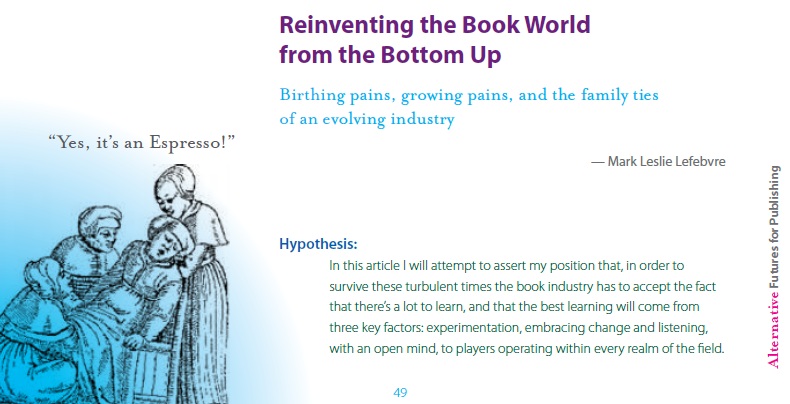
Titles Bookstore at McMaster University using an Espresso Book Machine and was working with many local self-published authors who wanted to use the machine to get their own print books into the world.
In fact, as an aside, I ended up, towards the tail end of 2011, getting paid to research and learn the ins and outs of self-publishing. I was hired by
Kobo as Director of Self-Publishing & Author Relations. The main focus of my role involved creating a DIY portal designed to make self-publishing easier for authors (Ironically, we’re getting close to the eve of releasing
Kobo Writing Life to the world – this was definitely something I could have used to make sure it was available at Kobo as quickly and easily as I made it available on Amazon)
A lot happened since I launched “
Spirits” as an eBook. Admittedly, there were days when I would obsessively go to the dashboard on
Smashwords or the Reports page on
Amazon and click refresh, hoping to see the sales of “Spirits” or one of my other eBook projects take off.
None of them ever did. Sure, sales trickled in here and there. But again, nothing major happened.
I even released a full audio version of “Spirits” on my Prelude to a Scream podcast feed. It received approximately 500 downloads.
But, again, uptake on sales was slow.
Instead of continuing to obsessively check on the sales that weren’t rocking any bestseller lists, I focused on a few other writing projects. I pitched a book to Dundurn Press that they accepted. I spent the rest of the summer madly researching and writing
Haunted Hamilton: The Ghosts of Dundurn Castle & Other Steeltown Shivers, which is coming out in August 2012. My novel
I, Death, which had been accepted by Atomic Fez, was also slated for publication in November 2012 (in time for World Fantasy Con which takes place in Toronto in November). Somewhere in there, I accepted the role of editor for the latest Tesseracts anthology and
Tesseracts Sixteen: Parnassus Unbound is slated to come out in September 2012.
And, of course, for my day job, I spent my time focusing on helping other self-published authors with their success via Kobo.com, while working with the development team on the building of the DIY portal that would become known as
Kobo Writing Life.
Also, in January of 2012 I realized that the cover I had designed, while it spoke directly to me about Greg Bartholomew, one of the characters in the story, didn’t really capture the type of tale I was telling. (Thie cover featured a photo a buddy of mine, Greg Roberts had taken – Greg occasionally allows me use of his fantastic photos for some of my book projects) The cover featuring the shadow of a tall man perfectly suited the character of Greg Bartholomew who is, in a sense, a shadow character. The shadow itself was also the perfect representation of the concept of leaving one’s “spirit” behind in a place.
 |
| The original cover for Spirits |
However, because, at its heart, this was a love story, I looked at the cover and wanted to come up with something that spoke of the tension in the relationship between Rob and Sally, the two star-crossed lovers that the story focuses on. I browsed a few sites before finding an image that I thought worked nicely. The image cost me $9.80.
Again, I wanted to employ the use of a shadow to denote leaving a spirit behind, and I kept the tag-line, "
People who haven't died can still leave their spirits in a place." I also threw in the words "love story" to try to appeal to those who might be intrigued by the non-speculative element to the tale, the love story between Rob and Sally, because at its heart, that's what the story was really about.
Interestingly, sales of “Spirits” picked up a little since I revised the cover.
 |
| The revised cover for Spirits |
So let’s now take a look at the end result of the sales of “Spirits” one year later.
Hmm. 87 units sold for a total of $46.37.
“Spirits” certainly wasn’t going to be allowing me to retire. And, if I wanted to round up the earnings to an even $50 (just for the sake of simple math), it would take me another 5 years before I earned the $300 I had originally hoped to make.
Of course, that doesn’t take into account the $10 I spent on the cover. But then again, I likely spent at least that much money on postage to send this story out over the years. And besides, while the story sat in a drawer, or spent time in slush piles, I was earning exactly $0.00 on it. At least now it is bringing in a few trickles of sales.
Again, I am not crushed. But nor am I sharing a great story of a successful self-publishing venture.
It also reminds me of the importance of outlining what success means in this space. Does success mean millions of downloads of tens of thousands of dollars? Or does it mean producing a product that I am truly proud of and which has entertained a relatively small group of readers?
So, I have learned that there are different ways to measure success. I perhaps learned that pulling this story from the drawer and making it available to readers has perhaps added to my brand. I have had reader feedback from people who have read this story and then moved on to purchase one of my books (in either print or eBook format) – and all because they took a chance and bought a short story for about a buck.
What Else Have I Learned?
1) Patience
The sales will continue to trickle in – slowly. Sure it’s great to be excited about a new publication, but spending every second focusing on it and worrying about whether or not it is selling isn’t going to help. Instead, I’m going to focus on producing more content, look at what I can do to continue to provide stories for those who are interested in reading them. And, as time passes, recognize that the trickle of sales continuing to come in is better than the zero eyeballs on my story while it languished in slush piles hoping to be published.
2) Change is good
With digital publishing if you don’t like the cover, you can change it. If you don’t like the price, you can change it. If the description for the blurb isn’t working, you can change it. Change is good, and so is experimentation. If something doesn’t work, you can fix it.
3) Mistakes Aren’t The End of the World
Certainly you don’t want to be making terrible balls-up mistakes every day. And there’s value in putting out content that matches a key element of an author’s brand. But that’s not to say that you can’t make mistakes. You can. And you should. So long as you learn from those mistakes and end up putting out a superior product. Think of the first draft of one of your stories. Is it always perfect the first time those words get laid down? Of course not. You edit them, you re-write, you refine. You iron out the mistakes, patch the errors, make it better. The same holds true in digital publishing. You can make mistakes and recover from them quickly.
4) Self-Publishing Is Not a Get-Rich Quick Scheme
At least, it isn’t for me. Nor will it be for the majority of writers out there. But then again, I’ve been a writer for a long time and I never suspected it would be easy. I expected it to be a lot of hard work, taking a lot of patience, a lot of practice and an extreme amount of dedication. I have, therefore, been conditioned to understand that self-publishing is no different than traditional publishing in that regard. As a traditional writer, I never commanded the million dollar advances that you often read about. And as a self-published writer, I doubt I will ever command the blockbuster audiences, sales and cashflow that are often celebrated.
5) Self-Publishing is Not for Everyone
There are certain projects and certain people who are simply not cut ouf for self-publishing. There are also particular works and particular projects for whom self-publishing is the dearest option. Recognizing that it’s not a black and white environment and there are a lot of shades of grey (the pun, for those who get is, is completely intended) is important. As I look at a few different writing projects on the horizon, I can see some of them better suited for traditional publishers and others better suited to my own self-publishing endeavours. And in my mind, there’s room for both.
I also learned a few things about making my work available in a broader market. If I had just stuck with Amazon, which, at the time, was the easiest system to use, I would have sold less than 20 units and pulled in less than ten dollars.
But making it available on Smashwords seemed to have done me some good. Through Smashwords the book sold decently on Smashwords as well as on Kobo, Apple and Barnes & Noble. Interesting how an upload to a single place pushed my story into multiple markets – there was value there in saving me time and energy. And the royalties rec’d from Smashwords ended up netting me an average of 58.8 cents per book as opposed to the 35.5 cents per book I rec’d from Amazon.
And there is the tale of a year in the life of one of my self-published stories. You’ll see that it didn’t make me rich, it didn’t make me famous. But it added to the greater “Mark Leslie” catalog and continues to entice new readers at a slow yet relatively consistent pace. And in the meantime I continue to enjoy my role working with self-published authors, those who are extremely successful in it and those who, like me, are making their way in the SP world without any stellar blockbusters but are enjoying the experience just the same.
And I’m JUST fine with that.